Why The "Fall Of Man" Myth is Humanity's Greatest Fear
A spiritual myth about separation, fear, and the long return to love

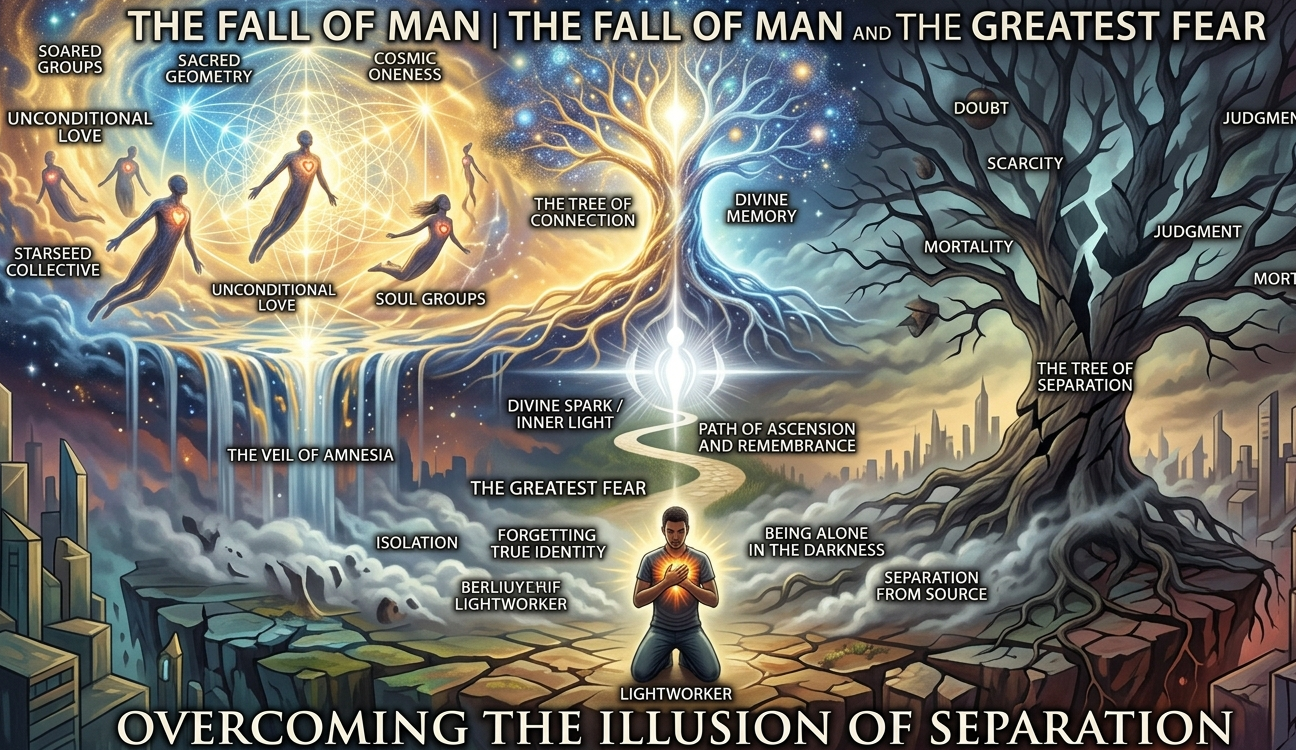
What if the “Fall of Man” was never a punishment, never a banishment, and never a cosmic mistake? What if it was a voluntary experiment—an immersion into a reality where the felt sense of God in the heart is temporarily offline, so consciousness can climb from “bottom” to “top” and rediscover love from the inside out?
1) The “Fall” as a Choice, Not a Crime
In the traditional story, humanity disobeys and is cast out of Eden. In this telling, the “Fall” is a myth built on a misunderstanding. The heavens—what I’ll call Reality itself—held a bold idea: experience a realm where beings can enter without the immediate, unmistakable feeling of God within the heart.
That absence would simulate disconnection. And in that simulation, growth would look like lifting oneself from the “bottom” to the “top”—a long arc of evolution where consciousness gradually re-learns alignment, wholeness, and inner love.
2) Collective Amnesia: The Memory-Loss Mode
To make the experiment real, the collective mind entered a kind of “memory loss” mode. The most important missing element wasn’t intelligence—it was the lived, heart-level certainty of God. Without that inner anchor, confusion appeared.
And in confusion, the mind often reaches for the same conclusion: I must have done something wrong. That’s where the greatest fear is born—the fear that the Creator (some say Father, some say Father-and-Mother) has withdrawn love, abandoned us, or pushed us away.
3) The First Blame, the First Split (and the Big Bang)
If the collective mind believes it has been “kicked out,” it will also look for a culprit. So parts of the One begin blaming other parts of the One. That inner accusation creates a split: “me vs. you,” “innocent vs. guilty,” “inside vs. outside.”
In this mythic language, that split is the moment we later label the Big Bang: consciousness expanding into the space we call the universe, scattering into countless fragments. Awareness becomes so divided it can experience itself as separate things—particles, atoms, bodies—each traveling its own path, carrying almost no memory of the Whole.
4) The Greatest Fear as the Root of All Fears
Even as fragments reunite into more complex forms—molecules, cells, organisms—the original fear lingers in the background: What if I’m unloved? What if I’m abandoned? What if I’m separated forever? It becomes the seed fear beneath all other fears.
Because it’s so painful to face, the mind buries it—deep, subconscious, almost unreachable. But buried doesn’t mean gone. Hidden fear keeps producing more fear, like a machine running in the background: anxiety, mistrust, shame, control, aggression, scarcity, and despair. Fear becomes kryptonite for the mind because it distorts perception at the root.
5) How Fear Turns into Blame (and Blame Turns into Suffering)
When a being carries unconscious guilt, it looks for somewhere to put it. That’s projection: “It’s your fault,” “They did this,” “Something out there is against me.” So life forms—especially humans—repeat the ancient pattern: we blame each other for a crime that never happened.
From this perspective, the tragedy is also a kind of divine joke: the One forgets itself, panics, divides, and then slowly wakes up—only to discover nothing was ever truly broken. The entire “fall” was a simulation of disconnection designed to make reconnection meaningful.
6) The Way Out: Re-Aligning with God in the Heart
The “exit” from fear isn’t winning a battle against the world; it’s restoring an inner alignment. The felt sense of God in the heart is the most secure feeling imaginable: pure love, deep satisfaction, and a steady faith that no matter what happens, you are held and cared for.
When people feel chronically sad, dry, or empty, this view says they’re not “broken”—they’re misaligned. They’ve drifted from their own soul’s orientation, and the result feels like distance from God. The closer the alignment, the more the heart fills. The more the heart fills, the less room fear has to operate.
7) A Simple Practice: Forgive the “Fall”
- Name the core fear. Quietly admit the hidden belief: “I might be abandoned.”
- Question the story. Ask: “What if no one was ever kicked out? What if separation is only a temporary experience?”
- Release the blame. Notice where you project guilt onto others, and practice letting it dissolve.
- Choose alignment. Aim your mind toward love—toward the kind of inner state that would exist if God were undeniably present in your heart.
- Repeat gently. This isn’t a one-time insight; it’s a re-training of attention and identity.
Conclusion: The End of the Game Is the End of Fear
In this story, humanity is still early in the game. We carry ancient background fear, and we often don’t know why. But evolution—inner and outer—keeps moving upward. As consciousness grows, it becomes increasingly capable of holding the feeling of God in the heart again.
And when a being is fully aligned—fully satisfied, fully awake—the fear vanishes because the premise that created it vanishes. Nothing was ever wrong; nothing was ever truly lost. The “Fall of Man” was not a fall at all, but a temporary forgetting on the way to a deeper remembering. The punchline of the divine joke is simple: things have always been good—and waking up is learning to see it.